Many traders struggle with one important concept:
Not every trading signal should be traded.
This is especially true during fast-moving futures markets where price action changes quickly and emotional decisions often lead to unnecessary losses.
In today’s trading session using DayTradeToWin software for NinjaTrader and TradingView, we break down exactly how professional traders use confirmation and signal alignment to make more structured trading decisions.
Before we begin, remember:
Trading is risky and not suitable for all investors. Never trade with funds you cannot afford to lose.
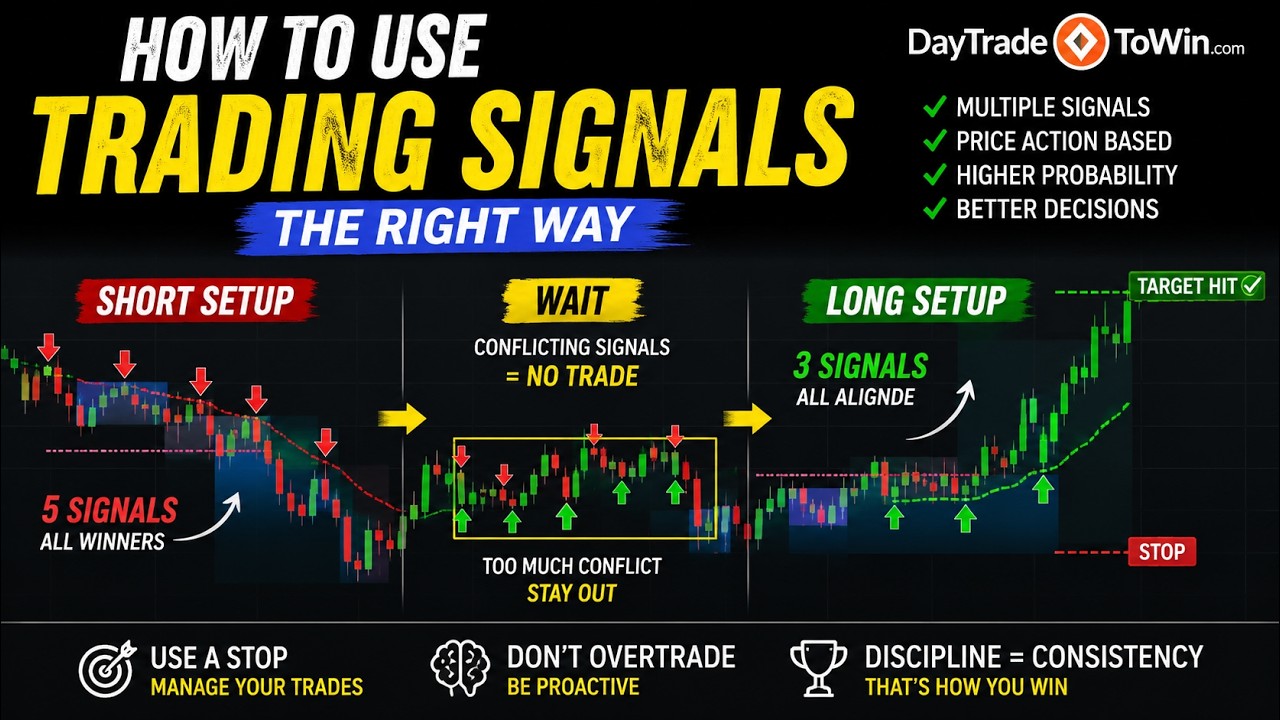

Multiple Signals to the Short Side
During the early morning session, the market provided several short-side trading signals.
Using structured price action rules, the signals were aligned in the same direction:
- short momentum
- bearish pressure
- confirmation across setups
In this case, the signals worked well because the market environment supported the trade direction.
This is one of the core principles we teach:
Aligned signals create clearer trading decisions.
When NOT to Trade
One of the most important educational moments came later in the session.
DayTradeToWin Trading Mentorship includes all the software for Ninja Trader and TradingView.
As the market began consolidating, we started seeing:
- long signals
- short signals
- mixed direction
- market indecision
This is exactly the type of environment traders should avoid.
Many traders make the mistake of continuing to force trades during consolidation periods. Instead of waiting for clarity, they overtrade emotionally and begin chasing market movement.
At DayTradeToWin, we teach the opposite approach:
if signals conflict, stay out.
No trade is often the best trade.
Why Signal Alignment Matters
Later in the session, the market began transitioning higher.
This time:
- multiple long signals aligned
- price action confirmed bullish direction
- the market structure became clearer
Now the trading environment made sense again.
Instead of:
- one signal long
- one signal short
- confusion
we had:
- confirmation
- alignment
- structure
This creates a much higher-quality trading environment.
Risk Management Always Comes First
Even with strong setups, risk management remains critical.
Every trade should include:
- a predefined stop
- a profit target
- proactive trade management
We teach traders to:
- avoid holding losing trades too long
- reduce emotional decision making
- protect trading capital first
A trade that remains against you for an extended period often becomes more dangerous over time.
Professional trading is not about hope.
It is about structure, discipline, and execution.
Avoid Overtrading
One of the biggest problems traders face is overtrading.
If you already had successful trades earlier in the session:
- there is no reason to continue forcing setups
- there is no need to constantly remain in the market
Sometimes the best decision is:
Take the profits and stop trading.
This helps reduce emotional fatigue and improves long-term consistency.
Price Action Trading Across Multiple Markets
The concepts shown in this session can be applied to:
- E-mini S&P futures
- Nasdaq futures
- Dow futures
- other futures markets
Because the trading methods are based on:
- price action
- confirmation
- market structure
rather than prediction.
TradingView and NinjaTrader Support

DayTradeToWin software supports both:
- TradingView
- NinjaTrader
Accelerated Mentorship includes all software shown on the charts in one package.
This includes:
- Sonic System
- Trade Scalper
- Atlas Line
- AutoPilot
- Price Action Training
Final Thoughts
The goal of successful trading is not prediction.
The goal is:
- confirmation
- discipline
- consistency
- structured execution
When signals align clearly, traders can make better decisions while avoiding emotional trading and market noise.
That is the foundation of professional price action trading.
Frequently Asked Questions
Trading signals are alerts or conditions that suggest a possible buying or selling opportunity based on price action, indicators, or market structure.
Conflicting signals often indicate market indecision or consolidation. This increases uncertainty and can lead to lower-quality trading setups.
Confirmation means multiple factors align in the same direction before entering a trade. This may include price action, momentum, market structure, and additional trading signals.
Overtrading occurs when traders continue taking unnecessary trades after reaching daily goals or during unclear market conditions. This often increases emotional decision making and losses.
Yes. DayTradeToWin software supports both TradingView and NinjaTrader platforms.
About DayTradeToWin
DayTradeToWin is a professional trading education company specializing in rule-based, non-predictive trading methods for futures markets. Our software and mentorship programs focus on confirmation, risk management, and trader discipline using structured price action analysis.
Learn more:
https://daytradetowin.com
Educational Disclaimer
Trading futures, stocks, and other financial instruments involves substantial risk and is not suitable for all investors. The content in this article is for educational purposes only and should not be considered financial or investment advice. Past performance does not guarantee future results.

John Paul is the founder of DayTradeToWin, a trading education and software platform established in 2008 with thousands of members worldwide. He specializes in price action-based futures trading strategies and structured market analysis.
DayTradeToWin provides trading education, indicators, and software tools designed to help traders apply disciplined, rule-based price action decision-making across global futures markets.
John Paul is the creator of several trading methodologies, including the Sonic System, Atlas Line, and Trade Scalper, used by traders to identify structured opportunities in markets such as the E-mini S&P 500 (ES), Nasdaq (NQ), crude oil (CL), and gold (GC).
Official website: https://daytradetowin.com