Pattern Day Trader Rule Explained:
Complete Guide to Day Trading Stocks With Less Capital
For more than 25 years, stock traders using margin accounts were subject to the Pattern Day Trader (PDT) Rule, which required a minimum account balance of $25,000 to actively day trade stocks. Recent regulatory changes have significantly altered these requirements, making stock day trading more accessible to traders with smaller account balances.
This guide explains what the Pattern Day Trader Rule is, what changed, how the new PDT rules work, and what traders should know before day trading stocks with less capital.
PDT Rule Changes
The pattern day trader (PDT) rule changes allow stock traders to trade with smaller accounts.
Old Rule $25,000
New Rule: $2,000 Margin Requirement
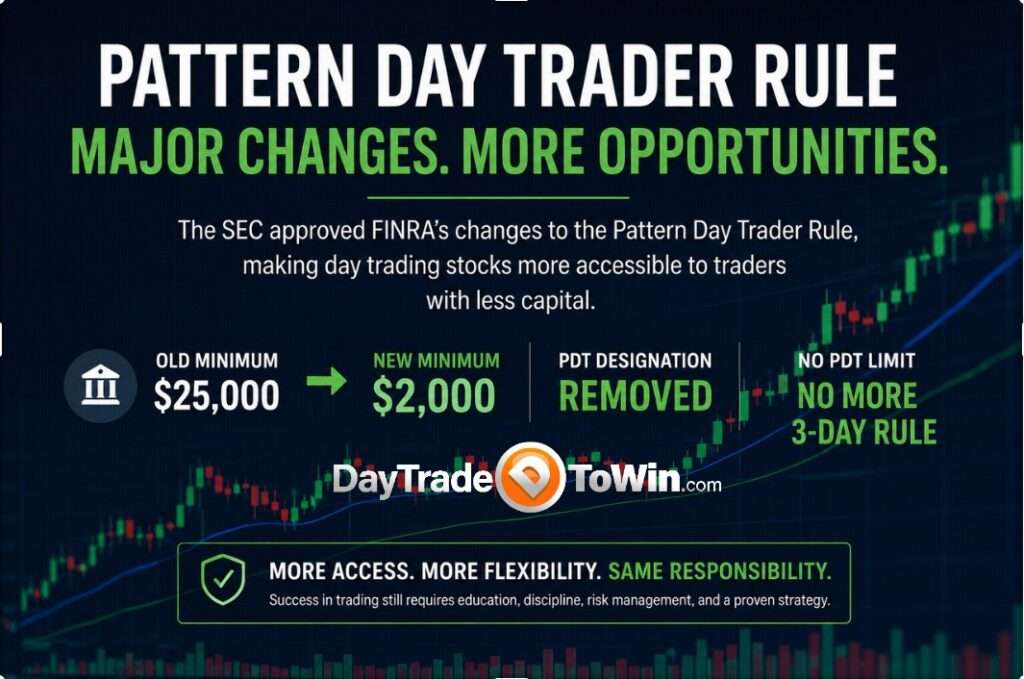
Table of Contents- Quick Search Links
What Is The Pattern Day Trader Rule?
On April 14, 2026, the SEC approved FINRA’s proposed changes to the Pattern Day Trader Rule, marking one of the most significant updates to stock day trading regulations in more than two decades. You can read their FINRA Rules on trading margins.
For more than two decades, the Pattern Day Trader (PDT) Rule has limited how often traders can day trade stocks in a margin account without maintaining at least $25,000 in account equity.
Under the original rule, traders who executed four or more day trades within a rolling five-business-day period could be designated as Pattern Day Traders and become subject to additional restrictions and account requirements.
The rule was originally introduced following the dot-com bubble in an effort to reduce risk among undercapitalized traders using margin accounts. While the goal was investor protection, many traders viewed the rule as a significant barrier to entry because it prevented active stock trading with smaller accounts.
Recent regulatory changes have significantly altered these requirements, making active stock trading more accessible to traders with smaller account balances.
What Changed Under The New PDT Rule?
One of the biggest changes to stock trading regulations provided by FINRA in recent years is the removal of the traditional Pattern Day Trader designation and the elimination of the long-standing $25,000 minimum account requirement.
Under the updated framework, margin account requirements are now based more heavily on real-time account equity and risk exposure rather than simply counting the number of day trades placed within a specific time period.
For many traders, this means greater flexibility, improved access to active trading opportunities, and the ability to begin learning with smaller account sizes.
| Feature | Old Rule | New Rule |
|---|---|---|
| Minimum Equity | $25,000 | $2,000 |
| Day Trade Limit | 3 in 5 Days | No PDT Limit |
| PDT Designation | Yes | Removed |
| Buying Power | Previous Day Calculation | Real-Time |
| Margin Monitoring | Limited | Real-Time |
Can You Day Trade Stocks With Just $2,000??
The short answer is yes, in many cases.
The updated rules allow traders to maintain margin accounts with significantly less capital than was previously required under the traditional PDT framework. However, individual brokerage firms may still establish their own requirements, margin policies, and buying power limitations.
Before opening a margin account, traders should understand:
- Broker-specific account minimums
- Margin requirements
- Real-time buying power calculations
- Risk associated with leverage
- Margin call procedures
While lower account minimums make stock trading more accessible, proper risk management remains essential.

What The New PDT Rule Means For Stock Traders
The removal of the traditional PDT restrictions creates new opportunities for traders who previously found the $25,000 requirement difficult to meet.
Benefits include:
Lower Barrier To Entry
New traders can begin learning with smaller account sizes.
More Trading Flexibility
Active traders are no longer limited by the traditional three-day-trades-in-five-days restriction.
Greater Access To Education
Smaller account requirements allow traders to gain practical experience while learning.
Improved Capital Efficiency
Traders can allocate capital more effectively while building experience.
However, traders should remember that easier access does not automatically result in profitability. Successful trading still requires discipline, education, and a proven trading methodology.
Why Was The PDT Rule Created?
The Pattern Day Trader Rule was originally introduced after the dot-com bubble burst in the early 2000s. Regulators were concerned that inexperienced traders were using excessive leverage in margin accounts and exposing themselves to significant financial risk.
The goal of the rule was to protect investors by requiring active stock traders to maintain a minimum level of account equity before day trading frequently.
While many supported the investor protection goals of the rule, critics argued that the $25,000 requirement created a barrier to entry for smaller traders while doing little to improve trading success. The recent changes reflect a shift toward real-time risk monitoring rather than restrictions based solely on trading frequency.
How DayTradeToWin Helps Active Stock Traders
Technology alone does not create successful traders. The most effective traders combine education, market understanding, risk management, and proven trading tools.
DayTradeToWin provides traders with software, indicators, and educational resources designed to help identify high-probability trading opportunities.
Popular tools include:
Atlas Line®
Designed to help identify trend direction and potential entry opportunities using a simple visual approach.
Trade Scalper®
Designed for traders seeking shorter-term trading opportunities with clearly defined signals.
Sonic System®
A comprehensive trading methodology focused on market structure, timing, and execution.
TradingView Indicators
For traders who prefer charting directly within TradingView.
NinjaTrader Indicators
For traders using one of the industry’s most popular trading platforms.
Accelerated Day Trading Mentorship+
Personalized training designed to help traders accelerate their learning curve.

The New PDT Rule Does Not Guarantee Trading Success
Many new traders mistakenly assume that removing the $25,000 requirement automatically makes day trading easier.
The reality is that trading success still depends on:
- Risk management
- Discipline
- Consistency
- Position sizing
- Emotional control
- Following a trading plan
The new rules provide greater access to the markets, but long-term success still requires education, practice, and a structured trading approach.
Can DayTradeToWin Software Be Used For Stocks?
Yes.
Many DayTradeToWin methodologies are based on price action, market structure, trend identification, and trading psychology—concepts that can be applied across multiple markets.
Depending on the product and trading style, traders may use DayTradeToWin tools when analyzing:
- Stocks
- ETFs
- Index products
- Futures markets
Understanding market structure and trader behavior remains important regardless of the market being traded.
How To Start Day Trading Stocks Under The New PDT Rules
The removal of the traditional Pattern Day Trader restrictions makes stock trading more accessible than ever before. However, successful trading still requires education, preparation, discipline, and proper risk management.
If you’re new to day trading, follow these six steps before risking significant capital.
Step 1 – Choose A Brokerage Account
The first step is selecting a brokerage account that supports active stock trading and offers the tools you need.
When comparing brokers, consider:
- Margin account requirements
- Trading platform quality
- Charting tools
- Order execution speed
- Market data availability
- Customer support
Many traders begin with a cash account before transitioning to a margin account as they gain experience and confidence.
Step 2 – Understand Margin Requirements
While the new PDT rules have reduced barriers to entry, traders still need to understand how margin works.
Margin allows traders to control larger positions using borrowed funds from their brokerage firm. While margin can increase buying power, it can also magnify losses.
Before trading on margin, understand:
- Account minimums
- Buying power calculations
- Margin calls
- Maintenance requirements
- Risk associated with leverage
Never use margin without fully understanding the risks involved.
Step 3 – Learn Risk Management
Risk management is one of the most important skills any trader can develop.
Many day trading beginners focus entirely on entries and exits while ignoring position sizing and risk control.
Consider establishing:
- Maximum daily loss limits
- Maximum risk per trade
- Defined stop-loss levels
- Realistic profit objectives
- Consistent position sizing
Professional traders focus on protecting capital first and generating profits second.
Step 4 – Practice Before Going Live
Before risking real money, spend time learning to day trade and practicing.
Many successful traders begin by:
- Studying market structure
- Learning price action
- Reviewing charts
- Tracking trades
- Testing strategies
The goal is to develop consistency before increasing position size or account risk.
Step 5 – Use Proven Trading Tools
Trading technology can help traders identify trends, improve decision-making, and maintain consistency.
At DayTradeToWin, we offer an all-inclusive accelerated day trading mentorship where traders have access to tools such as:
Atlas Line®
Helps identify trend direction and potential entry opportunities using a simple visual approach.
Trade Scalper®
Designed for active traders seeking shorter-term opportunities with clearly defined trade signals.
Sonic System
Combines market structure, timing, and trade execution concepts into a complete trading methodology.
TradingView & NinjaTrader Indicators
Professional tools designed to help traders analyze markets more efficiently and identify potential opportunities.
The goal is not to rely on indicators blindly but to combine technology with education and sound risk management principles.
Step 6 – Start Small
One of the biggest mistakes new traders make is trading too large too soon.
The new PDT rules may allow traders to begin with smaller accounts, but that does not mean larger positions should be used immediately.
Starting small allows traders to:
- Build confidence
- Develop discipline
- Learn from mistakes
- Refine execution
- Protect trading capital
Many successful traders focus on consistency first and account growth second.
Common Mistakes New Stock Traders Make
Trading Too Large
One of the fastest ways to damage an account is using excessive position size.
Ignoring Risk Management
Every trade should have a defined risk level before entering.
Chasing Trades
Many beginners enter after large moves have already occurred.
Overtrading
More trades do not necessarily lead to better results.
Misusing Leverage
Leverage can magnify gains but also magnifies losses.
Frequently Asked Questions
Is the Pattern Day Trader Rule gone?
Yes. The traditional Pattern Day Trader (PDT) designation and the $25,000 minimum equity requirement have been removed under the updated FINRA margin framework. Instead of counting day trades, brokers now focus on real-time account equity and margin requirements.
Can I day trade stocks with $2,000?
In many cases, yes. The updated rules allow traders to open margin accounts with significantly less capital than was previously required. However, individual brokers may establish their own account minimums and margin policies.
Can I day trade stocks with less than $2,000?
In most cases, traders need at least $2,000 to open a margin account. If you have less than $2,000, you may still be able to trade using a cash account, but cash account settlement rules apply. Before opening an account, check with your broker to understand their specific requirements and restrictions.
Do brokers still have their own rules?
Yes. While the Pattern Day Trader Rule has changed, brokerage firms can still establish their own account minimums, margin requirements, and risk controls. Some brokers may implement the new rules immediately, while others may introduce additional requirements based on account size, trading activity, or risk exposure.
Is the four day trades in five days rule gone?
Yes. The traditional rule that classified traders as Pattern Day Traders after executing four or more day trades within five business days has been removed under the updated framework. Traders are no longer restricted solely based on trading frequency, although other margin and risk requirements still apply.
Does the PDT Rule apply to cash accounts?
No. The Pattern Day Trader Rule historically applied only to margin accounts. Cash accounts are not subject to PDT restrictions, but they are subject to settlement rules. Traders using cash accounts must ensure they are trading with settled funds and understand how settlement timing affects buying power.
Does the PDT Rule affect options trading?
The updated rules may impact traders who actively trade options within margin accounts. However, options trading carries unique risks and brokerage-specific requirements. Traders should understand option approval levels, margin requirements, and the risks associated with options before trading.
Does the PDT Rule affect futures trading?
No. Futures trading has historically not been subject to the Pattern Day Trader Rule. This is one reason many active traders have preferred futures markets for years. Futures traders have typically been able to day trade without the $25,000 account requirement that applied to stock traders using margin accounts.
Can I still get a margin call?
Yes. Even though the Pattern Day Trader Rule has changed, margin calls can still occur. If account equity falls below required levels or positions create excessive risk exposure, brokers may issue margin calls, restrict trading activity, or liquidate positions. Understanding margin requirements remains essential for all active traders.
What brokers support the new rules?
Many major brokerage firms have announced plans to implement the updated margin framework. TradingView allows traders to use any broker in their ecosystem. However, implementation timelines and account policies may vary. Traders should contact their broker directly to confirm how the new rules apply to their account and what requirements remain in place.
Is day trading with a small account risky?
Yes. While the new rules make day trading more accessible, smaller accounts can be more vulnerable to losses if proper risk management is not followed. Successful traders focus on position sizing, capital preservation, and discipline rather than attempting to grow an account too quickly.
What is the best way to learn stock trading?
The best approach combines education, practice, risk management, and experience. Many traders begin by studying market structure, price action, chart patterns, and risk management principles. Using a simulator, maintaining a trading journal, and learning from experienced traders can help shorten the learning curve.
Can DayTradeToWin software be used for stocks?
Yes. Many DayTradeToWin methodologies are based on price action, trend analysis, and market structure concepts that can be applied across multiple markets, including stocks, ETFs, futures, and index products. Traders should review each product individually to determine the best fit for their trading style and objectives.
Can beginners use trading indicators?
Yes, but indicators should be used as part of a complete trading plan rather than as standalone buy and sell signals. Successful traders combine indicators with market structure, price action analysis, risk management, and proper trade execution. Education remains more important than any single indicator
How much money should a beginner start with?
There is no single answer because every trader’s financial situation is different. New traders should only use risk capital—money that can be lost without affecting their financial security or lifestyle. Many traders begin with smaller accounts while focusing on consistency, discipline, and education before increasing account size.
Final Thoughts
Summarize:
The Pattern Day Trader Rule has undergone one of the most significant changes in modern trading history. While the new rules make stock trading more accessible, successful trading still requires education, discipline, and a proven approach.
Whether you are trading stocks, ETFs, or futures markets, understanding risk management and market structure remains essential.
Stock PDT – Pattern Day Trader Rule Change: $25,000 Down to $2,000 – What Traders Need to Know
learn more about the PDT Small account stock traders have been waiting for.

How to Day Trade Stocks (Confirmation-Based Strategy That Works)
How to Day Trade Stocks Using Confirmation

Our trading courses and software day trading stocks
Yes, our trading methods work with stocks and futures markets! No additional indicator configuration or downloads are required. See all of our courses and software.
Look at this great long Atlas Line trade! The Long signal in the bottom-left corresponds with the entry. The entry is exactly where the arrow is pointing. Long and Short Atlas Line signals occur when there are two consecutive closing bars on either side of the Atlas Line. Later, we saw some great Atlas Line Strength signals as well. On average, expect two to four trades daily.
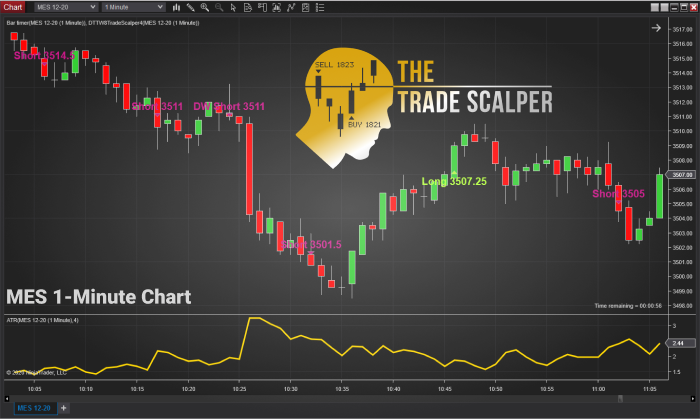
With the Trade Scalper, the goal is winning many small trades. It’s a fast, “in-and-out” trading style. Long and short signals appear of either the regular or “Double Wick” type. Small arrows further guide your trading. Because of the small amounts associated with these Mini markets and the smaller scalping profit goals, you may want to use more contracts.
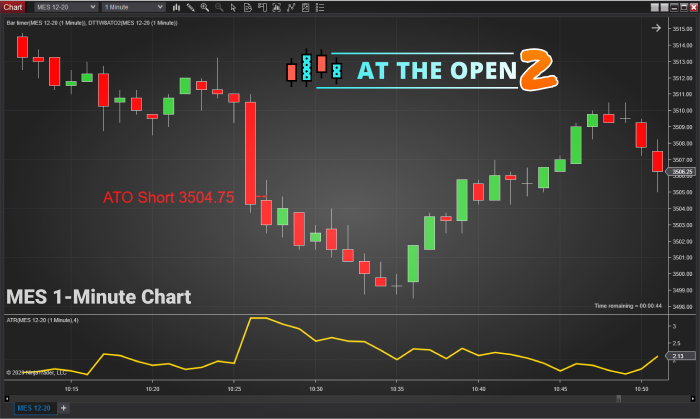
The ATO (At the Open) 2 focuses on finding winning moves soon after the market opens. Here, we have a great short signal. If you look closely, you will see this is the same morning as shown in the previous Trade Scalper chart. See how the methods compliment one another? On average, the ATO 2 produces one to two trades daily. Again, the goal is to capture the main morning move.
About DayTradeToWin
DayTradeToWin has been helping traders learn market structure, price action, and risk management since 2008. Our goal is to provide traders with educational resources, software tools, indicators, and mentorship programs designed to simplify the trading process and help traders develop consistency.
Thousands of traders worldwide use DayTradeToWin software and educational resources to analyze stocks, futures, ETFs, and other financial markets. Our trading methodologies focus on market structure, price action, disciplined execution, and risk management rather than prediction-based trading.
Whether you are a beginner learning how to day trade stocks or an experienced trader seeking additional tools and education, DayTradeToWin offers software, training, and mentorship programs designed to help traders build confidence and improve decision-making.
Popular DayTradeToWin Resources
- Accelerated Day Trading Mentorship+
- Sonic System®
- Atlas Line®
- Trade Scalper®
- TradingView Indicators
- NinjaTrader Indicators
- Free Trading Guide
- Day Trading for Beginners
Sources & References
This article references publicly available information from:
- SEC Order Approving FINRA Rule Change
- FINRA Regulatory Notice on Intraday Margin Requirements
- SEC Investor.gov – Pattern Day Trader Definition
For the most current regulatory information, traders should consult official SEC and FINRA publications directly.
Trading & Investment Disclaimer
The information provided on this page is for educational purposes only and should not be considered investment advice, financial advice, legal advice, or a recommendation to buy or sell any security, stock, ETF, option, futures contract, cryptocurrency, or other financial instrument.
Trading and investing involve substantial risk and are not suitable for every investor. Past performance is not indicative of future results. Any examples, charts, screenshots, hypothetical trades, or market commentary are provided solely for educational purposes and should not be interpreted as guarantees of future performance.
The Pattern Day Trader Rule changes discussed on this page are subject to brokerage implementation, regulatory updates, and individual account requirements. Traders should consult their broker and review official SEC and FINRA resources before making trading decisions.
Always conduct your own research and carefully consider your financial situation, risk tolerance, and investment objectives before participating in any financial market.