The U.S. stock market is entering a more fragile phase — but a new opportunity may be emerging where artificial intelligence meets the physical world.
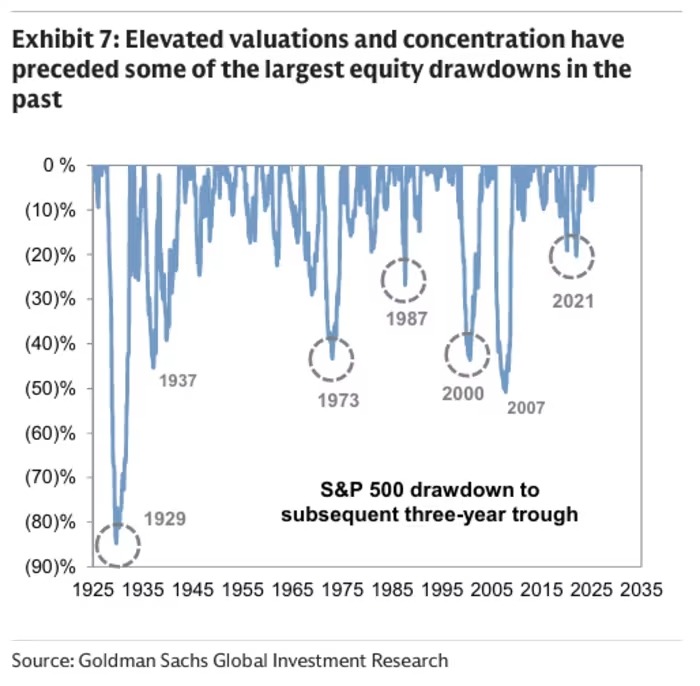
Goldman Sachs has reaffirmed its 7,600 year-end target for the S&P 500, implying roughly 9% upside from current levels. However, in a new note led by strategist Ben Snider, the firm warns that investors should prepare for a more challenging environment marked by high valuations, extreme market concentration, and strong recent returns.
According to Goldman, this combination closely resembles several historical market peaks — including the 1920s boom, the Nifty Fifty era of the 1970s, the 1987 bull market, the dot-com bubble of 2000, and the post-pandemic surge in 2021 — all of which ended in significant market drawdowns.
Is the Stock Market in a Bubble?
Goldman stops short of calling the current market a bubble, noting that some classic warning signs are missing. Speculative trading remains below the extremes seen in 2000 and 2021, IPO activity has been muted, equity fund flows are subdued, and corporate leverage is still relatively low — even though it is rising.
The firm defines speculative trading as activity in unprofitable companies, penny stocks, and stocks trading at more than 10 times enterprise value to sales.
On the macroeconomic side, Goldman says the biggest risks would come from either a sharp economic slowdown or a more hawkish shift in interest rate policy. For now, neither appears imminent. Still, the bank expects the backdrop to become less supportive later in the year as fiscal and monetary tailwinds fade and AI-driven disruption accelerates.
Slowing Earnings Growth and Rising Political Uncertainty
Looking ahead, Goldman expects S&P 500 earnings growth to slow slightly in 2027 compared to 2026. In addition, the approach of midterm elections could bring higher policy uncertainty and market volatility, as history suggests. While new policy tailwinds are possible, investors should prepare for a noisier market environment.
AI Spending Is Booming — But Debt Is Rising Too
One growing concern is the scale of AI investment. Goldman notes that corporate capital expenditures have surged to around 75% of cash flow, meaning future spending growth will increasingly be financed through debt.
“As spending and debt grow, so do the profits eventually required to justify those investments,” the strategists warn.
So far, mega-cap technology leaders such as Amazon, Alphabet, Meta, and Microsoft have seen their stock prices rise largely in line with earnings expectations. Unlike the late 1990s tech bubble, valuations today have not detached dramatically from near-term fundamentals.
Introducing “Phase 3-D”: Where AI Meets the Physical World
Goldman believes the next major leg of the AI investment cycle will not come from chips and data centers alone — but from AI-powered robotics and automation.
The firm calls this trend “Phase 3-D” — the stage where artificial intelligence moves beyond software and into the physical world.
A group of 26 stocks commonly held in U.S. robotics and automation ETFs — including Kratos Defense, Joby Aviation, AeroVironment, and Teradyne — delivered strong outperformance in early 2023 and again in 2025. Despite this, the group still trades at a relatively reasonable 26 times forward earnings.
Even more interesting: investor positioning remains light. The largest robotics ETFs attracted only about $750 million in inflows in the second half of last year, suggesting this theme is still under-owned and underappreciated.
The Next Phase of the AI Stock Trade
Goldman expects the AI trade to broaden as infrastructure spending slows and corporate adoption accelerates. The firm sees three key groups gaining attention:
- “Phase 4” companies that use AI to improve efficiency and margins
- “Phase 3” companies whose revenues benefit directly from AI adoption
- “Phase 3-D” companies that bring AI into the real world through robotics and automation
As this shift unfolds, robotics and automation stocks could become one of the most important — and overlooked — opportunities in the next chapter of the AI bull market.
Bottom Line: Robotics and Automation Could Be the Next AI Investing Boom
While Goldman Sachs warns that the broader stock market is entering a more fragile and volatile phase, the bank also sees a powerful new opportunity forming.
As artificial intelligence moves from the digital world into factories, warehouses, defense systems, and transportation, AI-driven robotics and automation stocks may become the next major winners of the AI revolution — and one of the most compelling investment themes for long-term investors.
About DayTradeToWin
DayTradeToWin® is a professional trading education company with over a decade of experience developing rule-based, non-predictive trading software for the futures markets.
Our methodology is built around structure — not opinions, news, or guesswork. Every strategy is designed to focus on:
- ✔ Market confirmation
- ✔ Risk management
- ✔ Trade timing precision
- ✔ Trader discipline
- ✔ Structured decision-making
We specialize in providing traders with objective tools that remove emotional bias and emphasize consistency over prediction.
DayTradeToWin’s software and educational programs are used by independent traders worldwide seeking a rules-driven approach to futures trading.
Educational Disclaimer
All content, software, training materials, and examples provided by DayTradeToWin are for educational purposes only and do not constitute financial, investment, legal, or trading advice.
Trading futures involves substantial risk and is not suitable for all investors. Past performance is not indicative of future results. Always trade with risk capital and consult a licensed financial professional before making investment decisions.