Stocks React as 10-Year Treasury Yield Nears 5%, Stirring Investor Anxiety
The U.S. bond market is off to a turbulent start this year, with a sharp selloff in Treasury securities rattling financial markets. Over the past week, yields on U.S. Treasury bonds have climbed significantly, pushing the benchmark 10-year Treasury yield dangerously close to the 5% threshold.
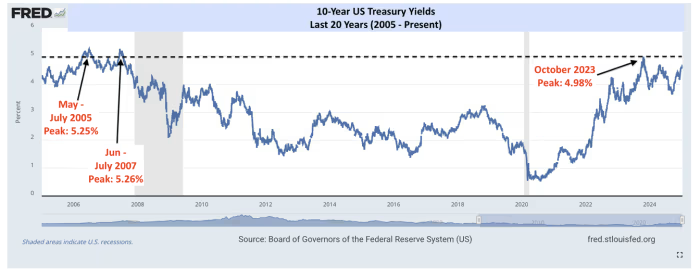
This level, rarely seen since the global financial crisis, has captured the market’s attention despite previous flirtations with the 5% mark in recent years.
“Stocks are spooked by the 5% level on the 10-year [yield] because it represents the outer limit of an entire generation’s experience with prevailing interest rates over the past two decades,” said Nicholas Colas, co-founder of DataTrek Research. “The last time we breached this level was mid-2007, and we all know how that story ended.”
Historical Context and Market Sentiment
The 10-year yield last surpassed 5% in June 2007, just months before the onset of the Great Recession. While the economic landscape of 2025 is notably different, with a more stable banking system but significantly higher U.S. federal debt, Colas points out that financial narratives often anchor to simple, psychologically significant benchmarks like the 10-year yield.
In his analysis, Colas suggests that while the U.S. economy might withstand a 5% yield, equity markets may struggle to adjust.
Recent Data and Market Impact
Last week, robust U.S. economic data led traders to speculate that the Federal Reserve might delay planned interest-rate cuts until the summer. This shift in expectations triggered a selloff in equities. The S&P 500 erased much of its postelection gains, and the Dow Jones Industrial Average experienced its worst start to a year since 2016.
Notably, the 10-year yield came close to 5% in October 2023, peaking at 4.987% before retreating. That episode also triggered a sharp decline in equities, highlighting investor sensitivity to rapid yield increases.
Structural Shifts Over the Last 20 Years
Colas emphasizes that, apart from a brief spike in 2023, the 10-year yield has remained well below 5% over the past two decades. Factors such as sluggish economic growth post-Great Recession and extensive Federal Reserve bond-buying programs have historically kept yields low.
Market Outlook
As of Monday, U.S. stocks showed mixed performance. The Nasdaq Composite fell 0.4%, while the S&P 500 and Dow Jones Industrial Average gained 0.2% and 0.9%, respectively. Meanwhile, the 10-year Treasury yield edged up to around 4.802%, and the 30-year yield reached 4.986%, according to FactSet data.
Investors now await key inflation data due later this week, which could further shape expectations for Federal Reserve policy and market direction.

John Paul is the founder of DayTradeToWin, a trading education and software platform established in 2008 with thousands of members worldwide. He specializes in price action-based futures trading strategies and structured market analysis.
DayTradeToWin provides trading education, indicators, and software tools designed to help traders apply disciplined, rule-based price action decision-making across global futures markets.
John Paul is the creator of several trading methodologies, including the Sonic System, Atlas Line, and Trade Scalper, used by traders to identify structured opportunities in markets such as the E-mini S&P 500 (ES), Nasdaq (NQ), crude oil (CL), and gold (GC).
Official website: https://daytradetowin.com