Market Timers Fled After Tuesday’s Sell-Off — And That’s a Bullish Signal
The sharp sell-off in U.S. stocks on Tuesday likely did not mark the end of the bull market — and the reaction from market timers helps explain why.
Historically, major market tops are characterized not by panic, but by stubborn optimism. Investors typically refuse to believe the bull run is over and continue treating every dip as a buying opportunity. That is not what happened this week.
Instead, short-term market timers moved aggressively to the sidelines. The average recommended equity exposure tracked by the Hulbert Stock Newsletter Sentiment Index (HSNSI) fell by nearly 20 percentage points in a single day — one of the steepest one-day declines since records began in 2000.
This behavior stands in sharp contrast to what occurred at the peak of the dot-com bubble. When the Nasdaq Composite peaked on March 10, 2000, it dropped more than 10% over the following two weeks — enough to qualify as a correction. Yet during that period, the HSNSI didn’t fall. It actually rose by 2.5 percentage points, showing that investors were still eager to buy the dip.
This week’s reaction is the opposite. Despite Tuesday’s decline being far smaller than the early-2000 selloff, market timers cut exposure dramatically instead of leaning in. That difference is telling.
From a contrarian perspective, true market tops usually form when investors remain confident that every decline is a buying opportunity. Additional confirmation comes from Yale professor Robert Shiller’s “Buy-on-Dips Confidence Index,” which measures how many retail investors expect the market to rise after sharp drops. Historically, the S&P 500 has performed much worse following periods of high dip-buying confidence than when that confidence is low.
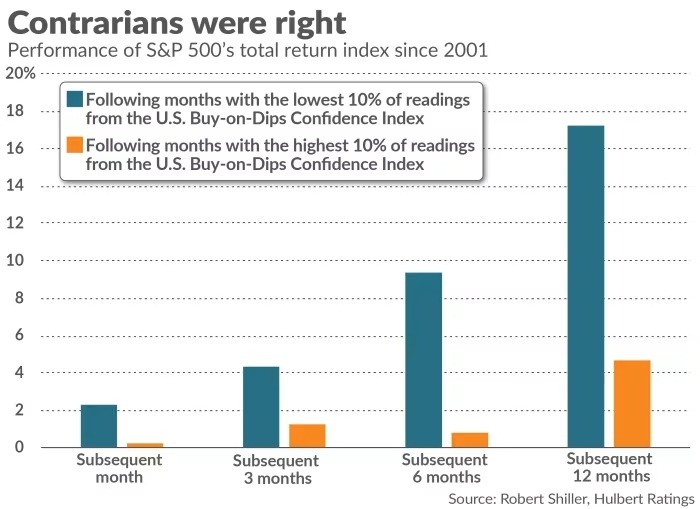
While Shiller’s index is published with a lag, the sharp drop in the HSNSI strongly suggests that confidence in buying dips has weakened substantially.
That said, this analysis applies mainly to the market’s short-term outlook. Valuations remain extremely stretched, and the bull market could still be approaching its later stages. But if history is any guide, the eventual major top will be accompanied by widespread disbelief — not the kind of fear-driven retreat seen after Tuesday’s sell-off.
In other words, investors running for the exits is usually not how bull markets end.
About DayTradeToWin
DayTradeToWin® is a professional trading education company with over a decade of experience developing rule-based, non-predictive trading software for the futures markets.
Our methodology is built around structure — not opinions, news, or guesswork. Every strategy is designed to focus on:
- ✔ Market confirmation
- ✔ Risk management
- ✔ Trade timing precision
- ✔ Trader discipline
- ✔ Structured decision-making
We specialize in providing traders with objective tools that remove emotional bias and emphasize consistency over prediction.
DayTradeToWin’s software and educational programs are used by independent traders worldwide seeking a rules-driven approach to futures trading.
Educational Disclaimer
All content, software, training materials, and examples provided by DayTradeToWin are for educational purposes only and do not constitute financial, investment, legal, or trading advice.
Trading futures involves substantial risk and is not suitable for all investors. Past performance is not indicative of future results. Always trade with risk capital and consult a licensed financial professional before making investment decisions.