UBS warns that CTA positioning could magnify any downside move in the market.
Between now and the next major U.S. options expiration on Dec. 19, markets face a trio of critical catalysts — the Fed decision on Wednesday, nonfarm payrolls on Dec. 16, and the CPI report on Dec. 18. UBS analysts say the combination of event risk and current positioning means even a modest drop could snowball into something bigger.
According to UBS, a decline in the S&P 500 to around 6,500 — roughly 5% below current levels — could trigger a dangerous inflection point. Their proprietary model, designed to track macro hedge fund behavior into options expiry, shows heightened sensitivity around the 6,850 level.
If the market starts sliding toward 6,500, commodity trading advisors (CTAs) — systematic, momentum-driven funds — are positioned in a way that would force them to sell aggressively, accelerating outflows.
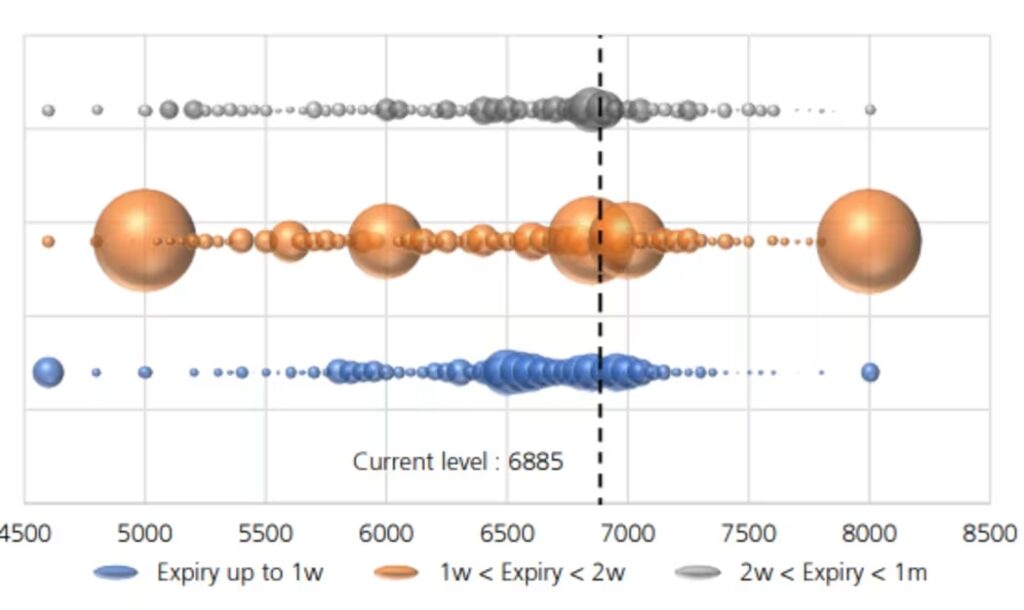
The Dec. 19 options expiry is capturing a heavy concentration of risk. Large open interest sits at the 5,000, 6,000, 6,850, and 8,000 S&P 500 strikes, highlighting peak uncertainty. Because CTAs rely on algorithmic trend-following strategies, their trading can significantly amplify market moves, especially near expiry when delta hedging dynamics kick in.
UBS notes that December’s expiry is particularly impactful because it closes out both the quarter and the year. Their model detects large exposures around those key S&P 500 strike levels and suggests CTAs have recently added risk but remain skewed toward selling.
If the index drifts toward 6,500, they would likely be forced to unload increasing amounts of futures to neutralize risk.
In Europe, CTAs are heavily long the Eurostoxx 50, currently near 5,700. A drop toward 5,600 could trigger similar selling pressure.
UBS also flags several other important CTA exposures: nearly max short positioning in the Japanese yen ahead of the Dec. 19 BOJ meeting, long exposure to the Chinese yuan, and sizable long positions in U.S. 10-year Treasurys that could become vulnerable if yields push back toward 4.25%.