Trading the Micro Nasdaq futures contract can be a useful way for traders to participate in the Nasdaq futures market while using a smaller contract size.
In this trading video, John Paul from DayTradeToWin walks through two short setups on the MNQ Micro Nasdaq using the Sonic System and Trade Scalper.
More importantly, the lesson focuses on what to look for before entering a short trade.
The goal is not simply to see a sell signal and immediately enter the market. Price action, signal location, trend direction, risk management, and trade confirmation can all play an important role in deciding whether a setup makes sense.
What Is the MNQ Micro Nasdaq?
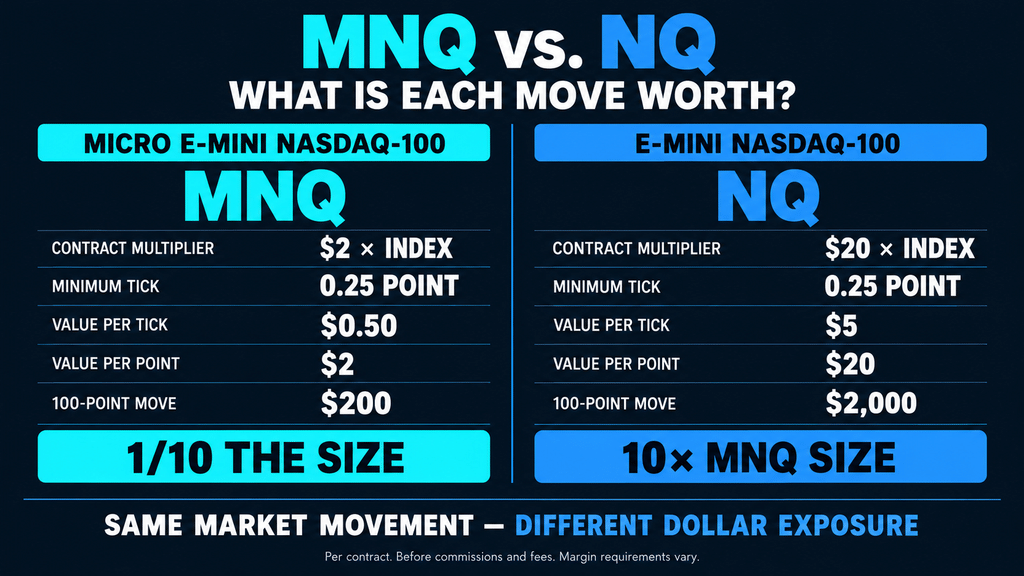
MNQ is one-tenth the size of the NQ contract, with the same market movement but significantly different dollar exposure.
The MNQ, or Micro E-mini Nasdaq-100 futures contract, is designed as a smaller version of the standard Nasdaq futures contract.
For traders who are newer to futures, the smaller contract size can make it easier to practice position sizing and risk management without immediately trading the larger contract.
In the video, John explains why newer traders may want to begin with one micro contract before considering additional position size.
The important idea is to learn the trading method first rather than immediately focusing on trading larger size.
Look at Where the Trading Signal Appears
One of the first things John looks at in the video is the location of the Sonic System signal.
When considering a short trade, he prefers to see the new short signal forming lower than the previous signal.
Why?
A lower signal can help confirm that price is already moving in the direction of the short-term trend rather than attempting to sell while the market is still pushing higher.
This is a simple price-action concept, but it can help traders avoid treating every individual signal exactly the same.
Start Small and Let the Trade Prove Itself
Another important concept demonstrated in the video is position management.
Instead of immediately entering the market with maximum size, traders can consider beginning with a smaller position.
If the market begins moving in the expected direction, the trader can then evaluate whether adding another contract makes sense.
The key distinction is that the additional position is being added after the trade begins working, rather than increasing risk while the market is moving against the position.
Newer traders should be especially careful with this technique.
There is nothing wrong with trading only one MNQ contract while learning.
Using Sonic and Trade Scalper Together
During the session, both the Sonic System and Trade Scalper generated short signals.
These are two separate DayTradeToWin trading methods.
A trader does not necessarily need both systems to take a trade, but having multiple trading methods on the same chart can provide additional information.
In this example, the Trade Scalper produced a short signal and was later followed by another Sonic short signal.
Both were pointing in the same direction.
That type of agreement can give the trader additional context when evaluating the market.
Pay Attention to Candle Wicks
With Day Trading Mentorship, all Signals and software are included are only part of the picture.
John also points out several candle wicks that appeared while the MNQ was moving lower.
Repeated lower wicks can indicate that buyers are stepping into the market and that price is having difficulty continuing lower.
This does not automatically mean the trade must be closed, but it is something traders should notice.
Price action can provide information that an indicator alone may not show.
If a short trade repeatedly attempts to move lower but quickly reverses upward, the market may be finding support.
How Long Should a Day Trade Take?
The examples in the video use a one-minute chart.
Because of that, John explains that traders should usually have a reasonable idea of how the trade is developing within several candles.
If five, six, or seven one-minute candles have passed, the trader can ask:
Is the trade moving toward the target?
Is it approximately break-even?
Is price moving against the position?
Is the market stalling?
The objective is not necessarily to enter a day trade and then hold it indefinitely.
For short-term trading, the way the market behaves shortly after entry can provide useful information.
Using ATR for Stops and Profit Targets
DayTradeToWin often uses the Average True Range, or ATR, as a guide for determining appropriate stops and profit targets.
Market volatility changes from one trading session to another.
A fixed stop that works well during a quiet market may be too small during a more volatile session.
Using ATR allows the trader to consider the current amount of market movement when determining risk and profit objectives.
Traders can still adjust their targets and stops according to their personal trading plan and risk tolerance.
Avoid Overtrading
One of the most important lessons in the video has nothing to do with indicators.
It is simply knowing when to stop trading.
More trades do not necessarily mean better trading.
John recommends focusing primarily on the first few hours of the trading session rather than continuing to trade throughout the entire day.
For many traders, the market can slow down during the afternoon.
Taking dozens of trades simply because the market is open can lead to unnecessary losses, commissions, and emotional decision-making.
The objective should be to identify quality opportunities rather than trade continuously.
MNQ Can Be Useful for New Futures Traders
The smaller contract size of MNQ makes it useful for traders who want exposure to Nasdaq futures while keeping position size smaller.
However, a smaller contract does not eliminate trading risk.
New traders should practice in simulation before trading live and develop clear rules for entries, stops, targets, position sizing, and daily loss limits.
The purpose of starting small is to build consistency before increasing risk.
Watch the Full MNQ Trading Video
In the full video, you can watch the trades develop in real time as the Sonic System and Trade Scalper identify short opportunities on the MNQ.
You will also see how price action, signal location, candle structure, targets, and trade management are evaluated as the market moves.
The Sonic System, Trade Scalper, Atlas Line, At The Open, and additional DayTradeToWin trading methods are available for traders who want a structured approach to price-action trading.
Trading involves substantial risk and is not suitable for everyone. Practice first and never trade with funds you cannot afford to lose.
About DayTradeToWin
DayTradeToWin provides futures trading education, trading software, indicators, and price-action strategies for traders using platforms including NinjaTrader and TradingView.
Founded by professional trader and educator John Paul, DayTradeToWin focuses on practical price-action concepts designed to help traders better understand market direction, trade entries, stops, profit targets, and risk management.
DayTradeToWin trading methods include the Sonic System, Trade Scalper, Atlas Line, At The Open, and other proprietary trading tools.
Traders interested in a more comprehensive learning experience can also explore the Accelerated Mentorship Program, which combines trading education with access to multiple DayTradeToWin trading methods and software.
Visit DayTradeToWin.com to learn more.
FAQ
What is MNQ in futures trading?
MNQ is the Micro E-mini Nasdaq-100 futures contract. It provides exposure to the Nasdaq-100 using a smaller contract size than the larger Nasdaq futures contract.
Is MNQ suitable for beginner futures traders?
The smaller contract size can make MNQ useful for traders learning futures and position sizing. However, futures trading still involves substantial risk, and new traders should practice in simulation before trading live.
What should I look for before shorting MNQ?
In this trading example, John looks at the location of the short signal, whether the signal is lower than the previous signal, overall price action, candle wicks, market momentum, and confirmation from additional trading methods.
What is the Sonic System?
The Sonic System is a DayTradeToWin trading method designed to identify trading opportunities based on market conditions and price action. It can be used with NinjaTrader and TradingView.
What is Trade Scalper?
Trade Scalper is another DayTradeToWin trading method designed for identifying short-term trading opportunities. In the video, Trade Scalper and Sonic both identify short opportunities during the MNQ session.
Why use ATR for trading stops and targets?
ATR measures market volatility. Traders can use it as a reference when determining stops and profit targets so that their risk parameters better reflect current market conditions.
How many trades should a day trader take?
There is no universal number. In the video, John emphasizes avoiding excessive trading and focusing on a smaller number of quality opportunities rather than continuously trading throughout the day.
Can Sonic and Trade Scalper be used together?
Yes. They are separate trading methods, but traders can place multiple DayTradeToWin methods on their charts to provide additional market information and confirmation.
Risk Disclaimer: Futures and day trading involve substantial risk and are not suitable for every investor. Past performance is not indicative of future results. The examples shown are for educational and informational purposes only and should not be considered investment advice, a recommendation to buy or sell any financial instrument, or a guarantee of future performance. Always practice in simulation first, use appropriate risk management, and never trade with money you cannot afford to lose.

John Paul is the founder of DayTradeToWin, a trading education and software platform established in 2008 with thousands of members worldwide. He specializes in price action-based futures trading strategies and structured market analysis.
DayTradeToWin provides trading education, indicators, and software tools designed to help traders apply disciplined, rule-based price action decision-making across global futures markets.
John Paul is the creator of several trading methodologies, including the Sonic System, Atlas Line, and Trade Scalper, used by traders to identify structured opportunities in markets such as the E-mini S&P 500 (ES), Nasdaq (NQ), crude oil (CL), and gold (GC).
Official website: https://daytradetowin.com