Retail Investors Stay Bullish on Stocks Despite Economic Uncertainty
A shaky economy isn’t dampening retail investors’ confidence in the stock market.
While economists often caution that the stock market doesn’t perfectly mirror the economy, retail investors appear to understand the distinction. Even as many are tightening their budgets in response to economic uncertainty, they’re continuing to invest—and even ramping up their exposure to risk assets.
That’s according to a new June survey from Finimize, an investment information platform for retail investors. Out of 2,338 respondents, 70% said they expect global stock markets to rise over the next 12 months. Meanwhile, 67% anticipate growth in cryptocurrencies. Both figures mark a noticeable increase in optimism since the second-quarter survey, which took place amid tariff hikes and trade tensions.
“This signals a real return to optimism,” said Carl Hazeley, CEO of Finimize. “The highest level of stock-market optimism we’ve ever recorded is around 72% to 74%, so we’re nearly back to those peak levels.”
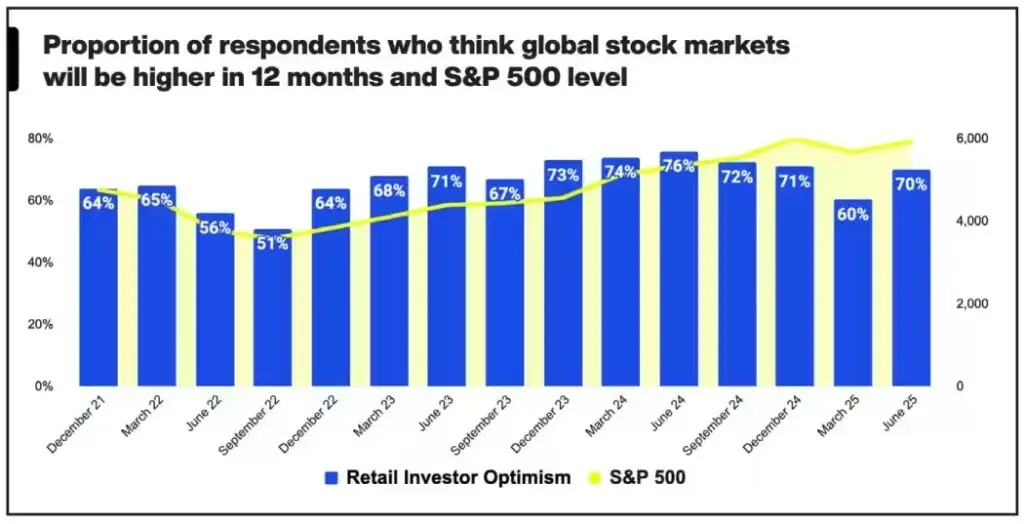
Hazeley pointed out that investor sentiment remained resilient even after April’s market turbulence, which saw the Dow slip into correction and both the S&P 500 and Nasdaq briefly dip into bear-market territory. Despite the volatility, most investors stuck with their strategies.
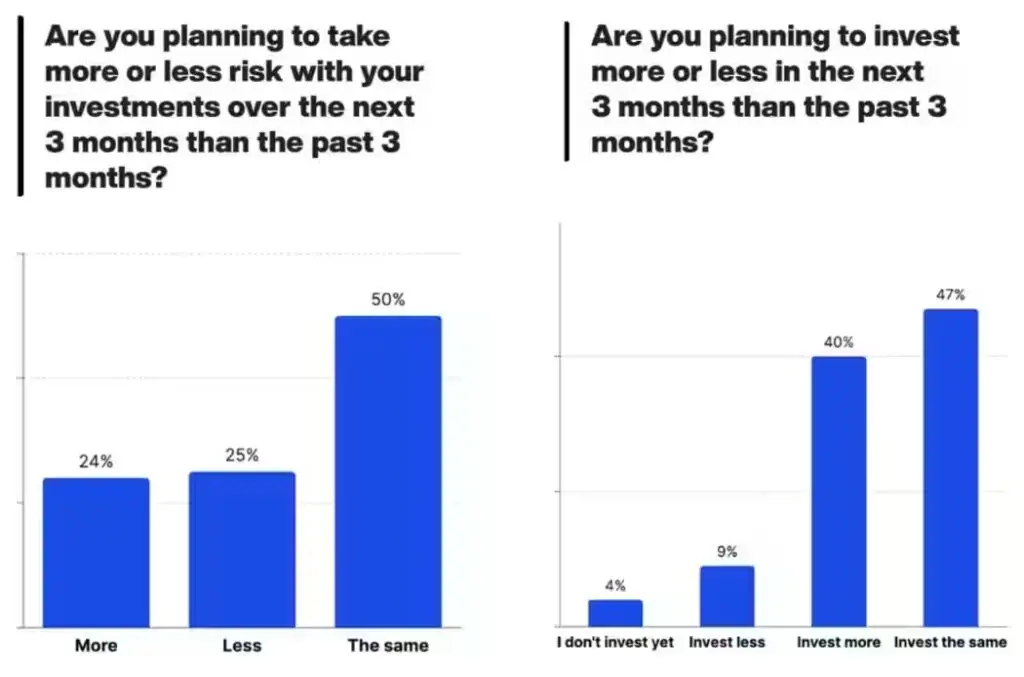
According to the survey, 47% of respondents plan to invest the same amount in the next three months as they did in the prior three months, and 40% plan to invest more. That’s significant, considering many investors had already increased their positions during April’s market pullback. Additionally, 47% said they intend to invest at least $10,000 over the coming year.
But while investment activity is holding strong, consumer behavior is shifting. Nearly 44% of those surveyed said they are cutting back on everyday spending to allocate more to investments. Of that group:
- 71% are spending less on dining out and entertainment,
- 60% on clothing and personal items,
- 36% on subscriptions, and
- 36% on travel.
This cautious consumer behavior reflects concerns about lingering risks—from potential recession to job security and persistent inflation. But it also underscores a shift in financial mindset.
“People are taking more control,” Hazeley said. “They’re thinking long term. A lot of them are cutting back on spending to pay themselves tomorrow—exactly what a financial adviser or budgeting app would recommend.”
In fact, a remarkable 89% of respondents said they view their investment accounts as a form of savings.
Despite the economic headwinds, retail investors aren’t retreating. Instead, they’re adjusting—spending less today to invest more for tomorrow.