SoFi’s Liz Thomas Makes the Case for a Contrarian Winner in 2025
Investor nerves are running high as year-end approaches, with Monday’s selloff showing little sign of dip-buyers stepping in. The culprits: renewed anxiety over AI and fading confidence that the Fed will deliver deeper rate cuts.
Tech — especially AI — has been the star trade heading into 2025, but some are beginning to question whether it’s time to look elsewhere. One of them is SoFi’s head of investment strategy, Liz Thomas, who sees healthcare positioning itself as a surprising outperformer into 2026.
Thomas notes that her bullish stance on healthcare going into 2025 was widely viewed as contrarian. A big factor was the arrival of HHS Secretary Robert F. Kennedy Jr., whose early policy moves rattled the sector. “The industry was bracing for changes from the administration, and it showed,” she told MarketWatch. “It was a rough year.”
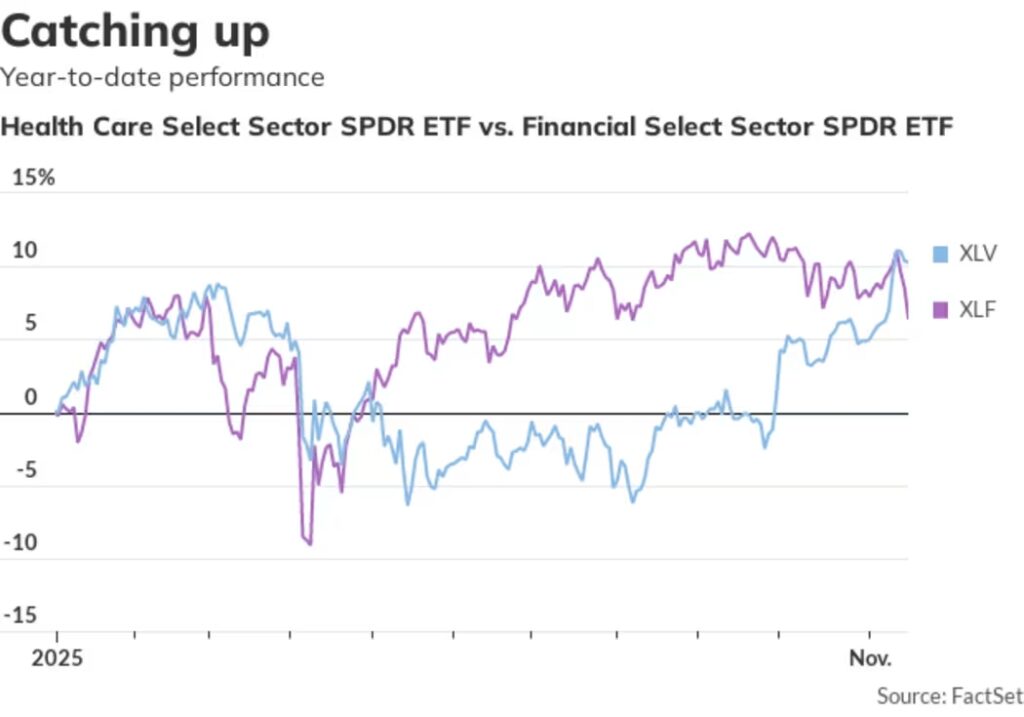
But she believes a “strong catch-up trade” may now be underway and still has conviction in the call she made early this year. “Healthcare could end up finishing 2025 as one of the top-performing sectors. It may even challenge industrials sooner than expected.”
And recent action supports her view: in just one week, healthcare has swung from one of the worst performers this year to outpacing financials. The Health Care Select Sector SPDR (XLV) is up roughly 10% year-to-date, compared to a little over 6% for the Financial Select Sector SPDR (XLF).
Thomas says the rotation is logical. As investors trim tech exposure but keep hunting for growth, they’re turning to areas with cheaper valuations. “Healthcare was in the lowest percentile of valuations versus the S&P 500 earlier this year. It doesn’t get much cheaper than that,” she said.
Pharma and biotech, in particular, are beginning to show both value and growth potential — a combination Thomas suggests could also make healthcare a standout again in 2026, as SoFi finalizes its outlook.
“For this year, I like healthcare for the catch-up trade, the valuation reset, and the growth potential in pharma and biotech,” she said, adding that the sector typically performs well in midterm years like 2026 due to its defensive nature.
Looking back at SoFi’s expectations entering 2025, Thomas said they were broadly bullish but wary of two risks: a resurgence in inflation and the possibility that AI earnings might disappoint. Neither has materialized so far, though she still sees vulnerabilities in the AI narrative.
One call that hasn’t played out yet: software outperforming semiconductors. But Thomas hasn’t abandoned the idea. As tech investors grow more valuation-sensitive, she believes many could rotate from semis into software — the layer that will ultimately bring AI to life for end users.
Following a nearly 800-point drop in the Dow, Thomas said the market is finally shedding some excess, particularly among momentum-driven trades. Still, she expects a year-end chase as fund managers scramble to catch up on performance.
Her cautionary note: “Everyone thinks they’ll get out before a crash. We don’t know if or when that happens, but when stocks stretch this far, some kind of reality check eventually comes.”