The “Debasement Trade” Gains Momentum Amid Dollar Weakness and Government Shutdown
The so-called “debasement trade” — a strategy popularized by retail investors in late 2024 as a hedge against a weakening U.S. dollar — appears to be gathering new momentum.
At the core of this trade is growing concern about the decline in the dollar’s purchasing power. Investors seeking protection from potential currency erosion are increasingly turning to gold and bitcoin, both of which have surged to record highs amid the ongoing partial government shutdown.
On Friday, gold futures (December delivery) settled at a record $3,908.90 an ounce on Comex — the 41st record high of 2025. Meanwhile, bitcoin briefly surpassed $125,000, setting another all-time high. The ICE U.S. Dollar Index (DXY), which tracks the dollar against six major currencies, slipped 0.1% on Friday and is down roughly 10% year-to-date.
According to analysts, the debasement trade could continue gaining traction, regardless of how long the shutdown lasts. Key drivers include persistent inflation uncertainty, concerns over U.S. fiscal policy and Federal Reserve independence, and ballooning government deficits across major economies.
“The debasement trade has shown strong momentum this year, with gold and bitcoin producing outsized returns,” said Matt Stucky, chief portfolio manager at Northwestern Mutual Wealth Management. “Falling real interest rates and renewed rate cuts amid elevated inflation are key catalysts behind this move.”
While not every government shutdown fuels this trade, analysts say today’s fiscal backdrop is different. The U.S. dollar, though stronger than during the 2018–2019 shutdown, faces long-term structural challenges — including rising debt and ongoing political dysfunction.
“High deficits and rising government debt have become bipartisan issues,” Stucky added. “That fiscal imbalance is an additional tailwind for the debasement trade.”
Recent data from J.P. Morgan shows that retail investors have been leading the charge, pouring capital into both gold and bitcoin ETFs since late 2024. Bitcoin inflows picked up after former President Trump’s tariff announcement in April, while gold ETFs have seen accelerating demand since August.
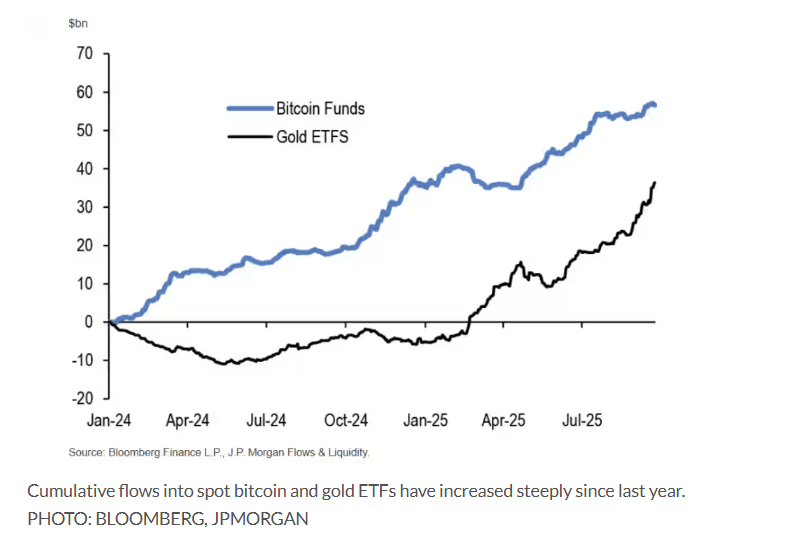
Institutional investors are now following suit, adding exposure through futures and ETFs, further reinforcing the trend.
At Citi, analyst Alex Saunders said bitcoin is increasingly viewed as “digital gold,” supporting its correlation with the precious metal. He sees the cryptocurrency climbing to $181,000 within 12 months, citing continued investor demand.
Others remain more grounded in traditional assets. Komal Sri-Kumar, president of Sri-Kumar Global Strategies, argues that gold remains the most reliable hedge against currency debasement.
“You can’t hide in fiat currencies when all are being debased,” he said. “That makes gold particularly attractive.”
Sri-Kumar expects gold to surpass $4,000 per ounce by year-end, citing rising inflation risks and potential political pressure for lower U.S. interest rates.
Meanwhile, veteran fund manager Jeff Muhlenkamp of Muhlenkamp & Co. views the shutdown as “a blip” in a broader, more worrying picture. His firm now holds 18% of assets in gold, a move he attributes to persistent concerns about America’s long-term fiscal trajectory.
“We’re running a deficit of 6% to 6.5% of GDP — that’s unsustainable,” he said. “The real debt burden isn’t improving, and these are still early days. The problem is getting worse, not better.”
With mounting deficits, fiscal strain, and a dollar under pressure, the debasement trade — once a fringe hedge — is increasingly shaping up as a defining theme of 2025’s markets.