Research Firm Warns: AI Boom Fueled by Cheap Money May Already Have Hit Its Limits
Artificially low interest rates have fueled massive investment into AI — but the technology may already be approaching its scaling ceiling, according to independent research firm MacroStrategy Partnership.
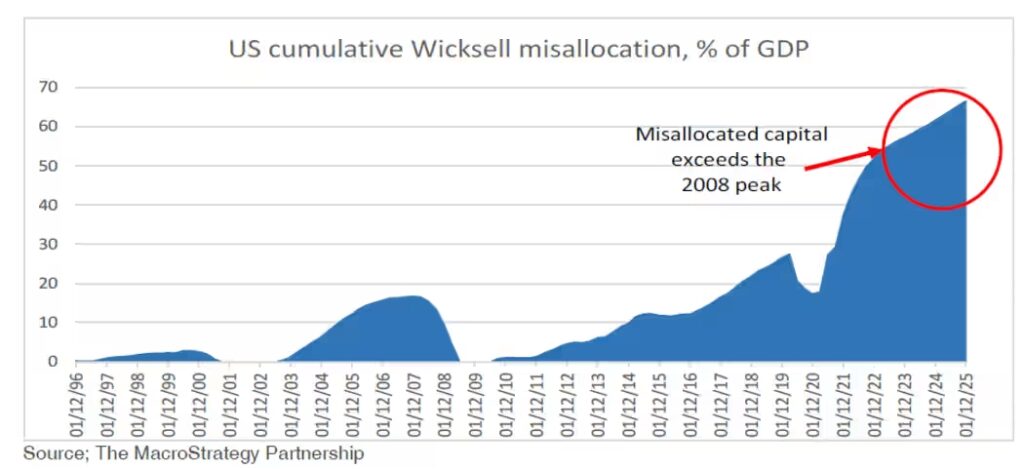
The firm, which advises over 200 institutional clients, issued a note led by analyst Julien Garran (formerly UBS’s head of commodities strategy), warning that today’s AI boom isn’t just another bubble. In fact, they argue it’s 17 times larger than the dot-com bubble and four times bigger than the 2008 real estate collapse.
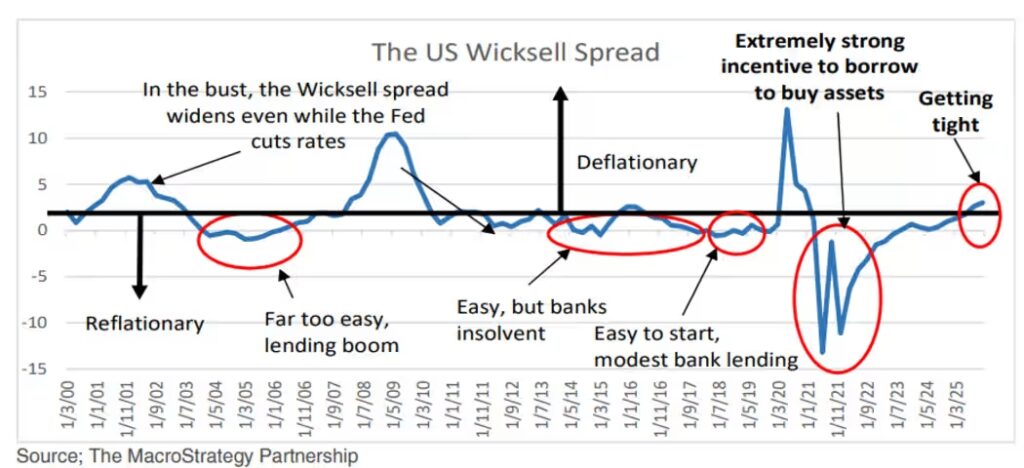
A Historical Lens: Wicksell’s Warning
The firm bases part of its analysis on the ideas of 19th-century Swedish economist Knut Wicksell. Wicksell argued that capital is efficiently allocated when corporate borrowing costs sit about two percentage points above nominal GDP growth. Instead, a decade of Federal Reserve quantitative easing compressed bond spreads, creating what MacroStrategy calls a “Wicksellian deficit.”
This deficit isn’t confined to AI — it also captures housing, commercial real estate, NFTs, and venture capital. In other words, trillions of dollars may be tied up in misallocated investments.
Limits of Large Language Models
MacroStrategy is equally skeptical about the underlying technology. They highlight evidence that large language models (LLMs) have already reached diminishing returns:
- At one software firm, task completion rates for LLMs ranged between 1.5% and 34%, and even those higher figures couldn’t be replicated consistently.
- U.S. Commerce Department data shows AI adoption by big corporations is already slipping.
- Simple real-world tests, like generating a valid chessboard scenario, have exposed glaring model limitations.
The economics look even worse: ChatGPT-3 reportedly cost $50 million to train, GPT-4 cost $500 million, and GPT-5 — delayed despite a staggering $5 billion price tag — failed to deliver a noticeable leap in performance. Competitors, meanwhile, are quickly catching up.
“There’s no moat on a model, costs explode with each generation, and the apps being built either have no commercial value or rely on copyrighted content,” the firm concludes.
Macro & Market Implications
MacroStrategy warns the fallout could mirror the dot-com bust of 2001. As data-center demand and wealth effects reverse, they see a high risk of recession, compounded by limited policy tools for the Fed or the Trump administration to reignite growth. A drawn-out reflation effort, similar to the post-S&L crisis recovery of the early 1990s, may be unavoidable.
Investment Playbook
The firm’s recommendations:
- Overweight: Resources and emerging markets (notably India and Vietnam)
- Underweight: AI and platform companies
- Long: Gold equities (GDX), short-dated U.S. Treasurys, volatility (VIX), and the yen against most currencies except the U.S. dollar