Banks Urge Investors to Diversify Into Commodities as Fed Turmoil Fuels Inflation Fears
This week could prove pivotal for the Federal Reserve’s independence. On Thursday, Stephen Miran, former President Donald Trump’s nominee for Fed governor, faces his Senate confirmation hearing.
By Friday, a judge may rule on whether Governor Lisa Cook can remain in her post after Trump sought to oust her via social media.
Markets are struggling to gauge how Trump’s push for a more compliant Fed—one that delivers lower rates—might ripple across assets. But both JPMorgan and Goldman Sachs say commodities stand at the center of the storm.
JPMorgan strategist Nikolaos Panigirtzoglou points to shifts already under way. Short bets in ETFs tracking long-term Treasurys signal investor anxiety over inflation and rising term premiums.
In equities, traders are tilting toward value stocks. In commodities, looser Fed policy could supercharge industrials like copper and oil, while gold has emerged as the clearest “Fed independence trade.” Long positions in gold futures have jumped sharply since Trump’s attempt to fire Cook.
Goldman Sachs echoes that message, highlighting supply-demand dynamics that reinforce the case for commodities. The bank warns that a weakened Fed could trigger higher inflation, steeper long-end yields, falling equities, and erosion of the dollar’s reserve status.
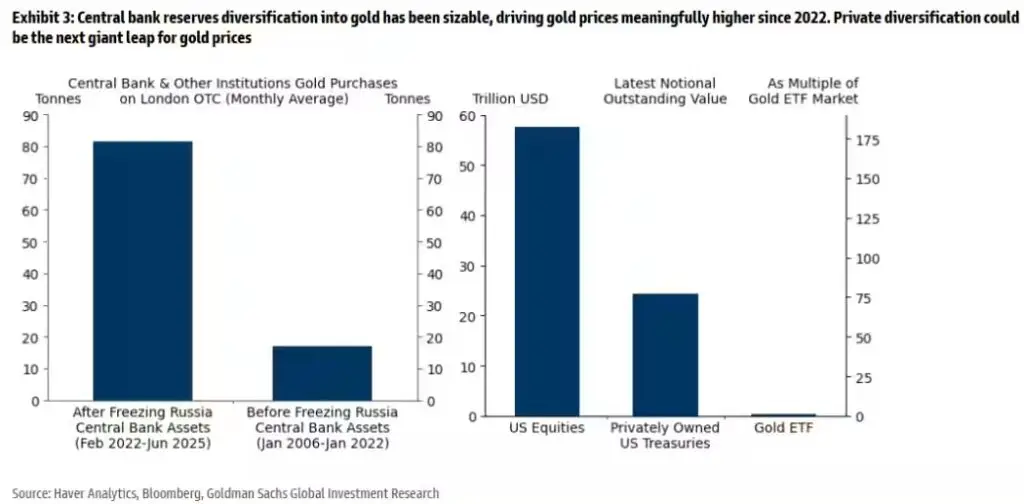
Gold, however, offers stability beyond institutional trust. Goldman sees prices climbing well above its $4,000 baseline projection for 2026, with potential to hit $4,500 in a tail-risk scenario. In fact, if just 1% of the privately held U.S. Treasury market shifted into gold, prices could surge near $5,000 an ounce.
With gold futures already breaching $3,600 on the NYMEX this week, Goldman calls the metal its “highest-conviction long” in commodities.