S&P 500 Could Climb to 7,100 Next Year, Say Strategists
Equity markets looked vulnerable on Wednesday as rising bond yields stirred investor anxiety ahead of a key Treasury auction. But Morgan Stanley struck a more optimistic tone, making a bullish call on U.S. stocks and bonds.
The bank’s strategists, led by Mike Wilson, upgraded their stance on U.S. equities and fixed income, citing “slow-but-not-dire” global growth. “We’re now neutral on global equities and constructive on bonds, but we see the U.S. as the most attractive region across asset classes,” the team said.
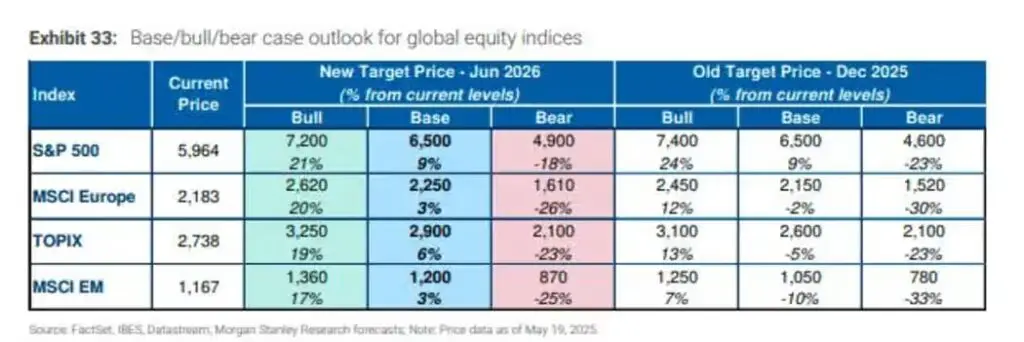
Previously, Morgan Stanley had forecast the S&P 500 reaching 6,500 by the end of 2025. That’s now their base case for Q2 2026, effectively pushing the timeline forward. Their bull case envisions the index climbing 21% to 7,200 by mid-2026, while their bear case puts it at 4,900. All projections are based on the index’s level of 5,964 as of May 19.
What’s Driving the Bullish Shift?
The strategists argue the market has already weathered “rolling earnings recessions” over the past three years, setting up more favorable year-over-year comparisons and laying the groundwork for a synchronized earnings-per-share (EPS) recovery.
They expect the EPS rebound to be driven by factors such as potential Fed rate cuts in 2026, a weakening U.S. dollar, and productivity gains from artificial intelligence.
Morgan Stanley also believes the worst may be behind us. “The tariffs announced on ‘Liberation Day’ triggered what can only be described as capitulatory selling. Assuming we avoid a deep recession, we think those were the price lows,” the strategists noted.
Looking ahead, they foresee a policy landscape supportive of markets — with infrastructure incentives, tax cuts, deregulation, and rate reductions expected over the next 6–12 months.
A recent pause in U.S.-China tariff tensions has meaningfully lowered recession risks, according to Morgan Stanley. Their economists now forecast seven rate cuts in 2026, which they say should help support above-average equity valuations.
Short-Term Risks and Longer-Term Outlook
The 10-year Treasury yield, currently at 4.55%, remains a short-term concern. Morgan Stanley expects yields to stay rangebound through the end of 2025, before falling to 3.45% by Q2 2026 as markets begin to anticipate Fed easing.
In the near term, these higher yields are expected to constrain equity valuations, keeping the S&P 500 within a range of 5,500 to 6,100 for the first half of 2025. But beyond that, the index is projected to trend toward the 6,500 mark.
This 6,500 target assumes a 21.5x forward price-to-earnings multiple on $302 in expected 12-month EPS. That projection is more likely to be reached by mid-2026, given recent market weakness and the delayed effects of tariff-related uncertainty on corporate earnings.
Stock Picks and Sector Strategy
Morgan Stanley recommends investors focus on high-quality cyclical stocks — companies with strong balance sheets, consistently high returns, and lower leverage. They’ve also upgraded their view on the industrials sector from neutral to overweight, citing the Biden administration’s push for domestic infrastructure investment.
Utilities have also been lifted to overweight, reflecting a shift away from defensive sectors. The strategists continue to favor large-cap over small-cap stocks and U.S. equities over international ones, as earnings revisions for American companies begin to trend upward.
On the currency front, Morgan Stanley expects the U.S. dollar to weaken, with the ICE Dollar Index potentially falling 9% over the next year. As U.S. rates and growth normalize relative to other economies, the euro, Swiss franc, and Japanese yen are seen outperforming as safe-haven currencies.