This year’s surge in the Dow Jones seemed to favor Democrats and Kamala Harris in the presidential election, yet it highlighted the growing disconnection between Wall Street and Main Street. While the stock market has often been viewed as a predictor of election outcomes, it missed the mark this time, prompting a need to investigate why.
For months, I referenced a model that linked the incumbent party’s re-election chances to the Dow Jones Industrial Average’s year-to-date performance. Just before the election, this model predicted a 70% chance for Vice President Kamala Harris, the Democratic candidate, to prevail over former President Donald Trump.
When predictions miss, however, it’s a cue to examine underlying assumptions. Was this simply an example of a model failing, which is inevitable in forecasting? Or does this reflect deeper shifts in the relationship between the economy and markets, rendering the model outdated?
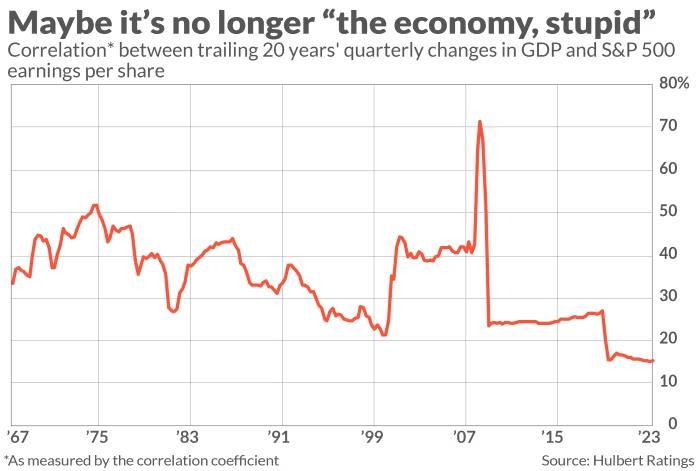
Post-election analysis points to an enduring disconnect between Wall Street and the broader economy, the so-called Wall Street-Main Street gap. Historically, the Dow aligned with economic health and voter sentiment, but this correlation has weakened. Voters still consider their financial well-being, yet the Dow no longer serves as an accurate barometer of everyday economic conditions.
To illustrate, I analyzed the 20-year correlation between quarterly U.S. GDP growth and S&P 500 earnings per share (EPS) since 1947. This correlation, once as high as 40% in the early 1990s, has fallen to 15%. Aside from a temporary increase after the 2008-09 financial crisis, this alignment has been declining for decades.
This trend explains why a bullish stock market didn’t translate to greater support for Kamala Harris. Despite market gains, many Americans face ongoing financial challenges. The implications for analysts and forecasters are significant: traditional economic metrics may hold less predictive power, and there may be greater need to focus on individual company dynamics over broader economic trends.
Vincent Deluard, StoneX’s global macro strategy director, recently emphasized this shift, noting that “investors spend far too much time worrying about the next recession. Economic growth is just one small driver of stock prices. Margins and multiples matter a lot more to stock prices.” In other words, understanding stock performance may hinge more on profit margins and valuation multiples than on economic growth alone.
This shift doesn’t make forecasting easy—projecting profit margins or P/E multiples remains complex. But recognizing the diminished role of economic growth allows for a more targeted focus on the factors that truly drive stock prices in today’s market.

John Paul is the founder of DayTradeToWin, a trading education and software platform established in 2008 with thousands of members worldwide. He specializes in price action-based futures trading strategies and structured market analysis.
DayTradeToWin provides trading education, indicators, and software tools designed to help traders apply disciplined, rule-based price action decision-making across global futures markets.
John Paul is the creator of several trading methodologies, including the Sonic System, Atlas Line, and Trade Scalper, used by traders to identify structured opportunities in markets such as the E-mini S&P 500 (ES), Nasdaq (NQ), crude oil (CL), and gold (GC).
Official website: https://daytradetowin.com