Monday saw the S&P 500 finishing below its 50-day average amid robust retail sales figures and a temporary easing of tensions between Iran and Israel, nudging Treasury yields upwards.
With the benchmark index now 2% lower than its late March peaks, trading has been volatile following unexpected inflation spikes, geopolitical tensions, and a lackluster start to first-quarter earnings reports.
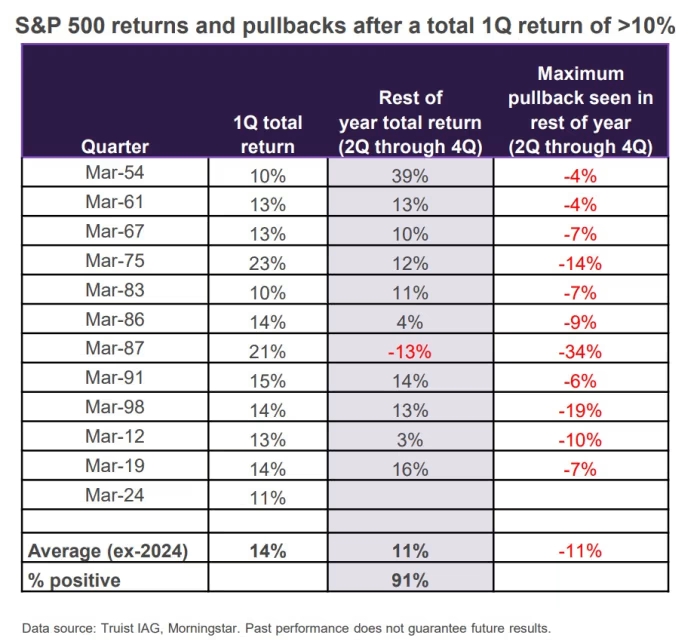
Keith Lerner, Truist Advisory Services’ chief market strategist, noted that market retractions are typical, with only a few years in the past four decades escaping pullbacks exceeding 5%.
Analyzing S&P 500 returns and pullbacks post a first-quarter surge of at least 10%, Lerner found average drawdowns of 11% for the remainder of the year. Nonetheless, the total return for quarters two through four averaged 11%, with 91% being positive—barring the exceptional case of 1987.
Lerner remains optimistic about stocks, citing the economy’s resilience. He emphasized the historical lesson that a robust economy with minimal rate cuts fares better than a weakening one requiring significant cuts, which should buoy earnings.
Furthermore, Lerner highlighted stocks’ role as a partial hedge against inflation, given its correlation with increased sales and earnings.
Despite rising oil prices, recessions typically follow year-over-year gains of over 80%, which current figures fall short of, with just a 5% increase in the front-month contract over the last year.
Lastly, Lerner pointed to strong price support for the S&P 500 in the 4,800 to 5,000 range, with structural support at 4,600.
In conclusion, Lerner maintains that the evidence suggests a bull market, although the ongoing correction may have further to run in terms of price and/or duration. He advises sidelined investors and those below target equity allocations to consider dollar-cost averaging and potentially increasing investments during a deeper, more typical correction.

John Paul is the founder of DayTradeToWin, a trading education and software platform established in 2008 with thousands of members worldwide. He specializes in price action-based futures trading strategies and structured market analysis.
DayTradeToWin provides trading education, indicators, and software tools designed to help traders apply disciplined, rule-based price action decision-making across global futures markets.
John Paul is the creator of several trading methodologies, including the Sonic System, Atlas Line, and Trade Scalper, used by traders to identify structured opportunities in markets such as the E-mini S&P 500 (ES), Nasdaq (NQ), crude oil (CL), and gold (GC).
Official website: https://daytradetowin.com