Why Big Geopolitical Shocks Usually Turn Into Buying Opportunities
Major geopolitical shocks over the past quarter-century have almost always ended up being buying opportunities once the initial panic fades — and strategists at HSBC believe the current Greenland crisis is unlikely to be an exception.
The escalation of tensions around Greenland and the tariff risks it has unleashed triggered a broad sell-off across global markets, hitting a rare trifecta of U.S. assets: stocks, bonds and the dollar.
On Tuesday, the S&P 500 slid 2.1%, while the 10-year Treasury yield rose 6 basis points to 4.29%, and the dollar weakened against the euro, British pound and Canadian dollar. The rush to safety benefited only a handful of traditional havens, with the Swiss franc and gold posting solid gains.
But according to HSBC’s chief multi-asset strategist Max Kettner, episodes like this historically tend to be temporary. In a note published Tuesday, Kettner said that roughly 75% of geopolitical and macro crises over the past 25 years have ultimately been “faded” by markets — meaning the initial pessimism subsides and asset prices gradually recover. For that reason, he and his team are resisting claims that “this time is different.”
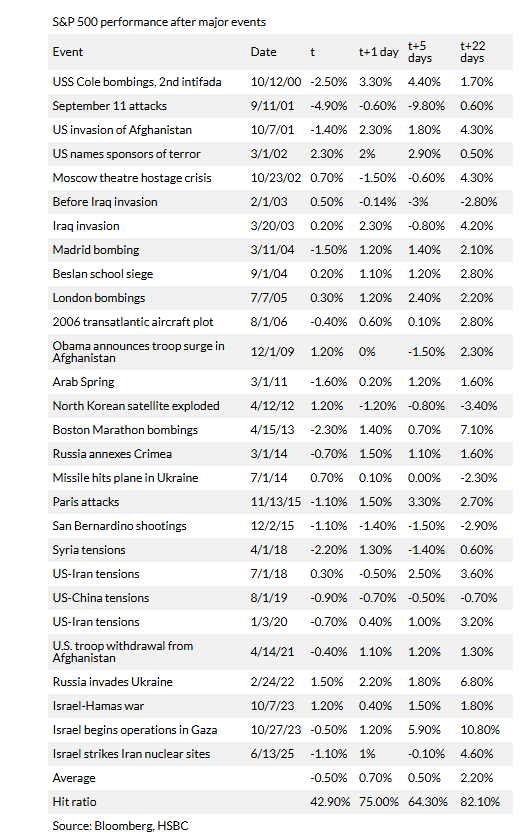
Kettner pointed to recent examples, including the 2025 market turmoil following President Donald Trump’s “Liberation Day” tariff announcement and the Israeli strikes on Iran, as proof that looking through short-term volatility has paid off. He expects a similar pattern this time, with tough initial rhetoric eventually giving way to negotiation and compromise.
Still, HSBC is not complacent. Kettner warned that U.S. rates and risk assets are approaching a “danger zone.” He highlighted 4.4% on the U.S. 10-year yield and 5% on the 30-year bond as key technical levels. A decisive break above those thresholds, he said, could trigger a more prolonged period of weakness across markets.
For now, however, he does not expect that outcome. Kettner argues that U.S. economic growth, the labor market and inflation remain in a “Goldilocks” environment — strong enough to support earnings but not hot enough to force the Federal Reserve into a more hawkish stance. That should help preserve expectations for two rate cuts in 2026.
He also noted that the VIX futures curve remains in backwardation — with near-term contracts priced higher than longer-dated ones — a technical signal that markets may already be oversold. In addition, with fourth-quarter earnings expectations set relatively low, companies may have an easier hurdle to clear, potentially providing another boost to equity sentiment.
Taken together, HSBC believes the current sell-off is more likely to prove another temporary shock than the start of a lasting downturn — and one that could eventually reward investors willing to look past the volatility.
About DayTradeToWin
DayTradeToWin® is a professional trading education company with over a decade of experience developing rule-based, non-predictive trading software for the futures markets.
Our methodology is built around structure — not opinions, news, or guesswork. Every strategy is designed to focus on:
- ✔ Market confirmation
- ✔ Risk management
- ✔ Trade timing precision
- ✔ Trader discipline
- ✔ Structured decision-making
We specialize in providing traders with objective tools that remove emotional bias and emphasize consistency over prediction.
DayTradeToWin’s software and educational programs are used by independent traders worldwide seeking a rules-driven approach to futures trading.
Educational Disclaimer
All content, software, training materials, and examples provided by DayTradeToWin are for educational purposes only and do not constitute financial, investment, legal, or trading advice.
Trading futures involves substantial risk and is not suitable for all investors. Past performance is not indicative of future results. Always trade with risk capital and consult a licensed financial professional before making investment decisions.