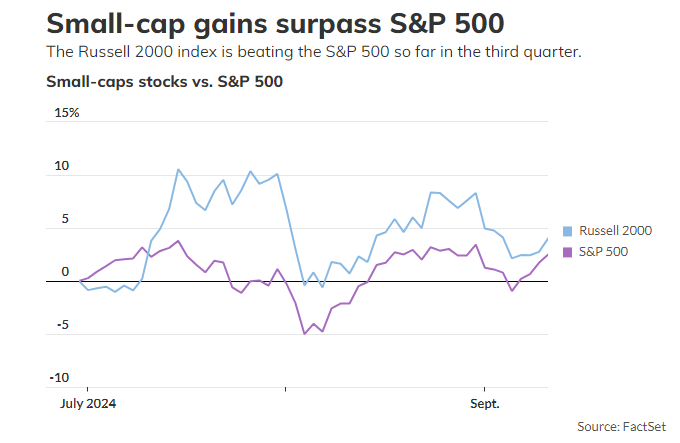
On Thursday, the small-cap-focused Russell 2000 index surged, reflecting the strength of U.S. small-cap stocks, which have been outperforming the S&P 500 during the third quarter. Despite facing greater losses than large-cap stocks in September, small-caps are showing resilience.
“Small caps received a boost when the Federal Reserve signaled a move toward easier monetary policy,” said Liz Ann Sonders, chief investment strategist at Charles Schwab, during a Thursday phone interview. This policy shift became clear during the Jackson Hole Economic Symposium in late August. “Historically, small caps tend to perform well during a rate-cutting cycle,” she added, although this effect is typically more pronounced when the Fed cuts rates in response to a recession.
“But we’re not in a recession,” Sonders clarified. “While the economy is slowing, it remains relatively strong.”
The Russell 2000, an index tracking small-cap stocks, has gained 4% this quarter, even after a 4% decline in September. In comparison, the S&P 500, which measures large-cap stocks, has posted a smaller 2.5% gain for the quarter but remains far ahead for the year overall, according to FactSet data.
Investors are anticipating that the Federal Reserve will announce a rate cut at its upcoming meeting, marking a shift from the elevated levels held since July 2023. This period of high rates followed a series of hikes aimed at curbing inflation, which peaked in 2022 but has since moderated towards the Fed’s 2% target.
According to CME’s FedWatch Tool, traders on Thursday saw a 69% chance that the Fed will lower rates by a quarter percentage point to a range of 5% to 5.25%. Sonders warned that investors seeking a larger cut should “be careful what you wish for,” as steeper reductions usually come during recessions or financial crises.
The recent rally in small-cap stocks has cooled slightly as expectations for rate cuts have shifted from a half-point to a quarter-point decrease, leading to some profit-taking. Small-cap stocks typically benefit more from rate cuts than larger companies, Sonders noted.
However, she also emphasized the importance of focusing on quality when investing in small-caps. The Russell 2000 contains a wide variety of stocks, and their performance can vary significantly based on their quality. “The economy is slowing, so if you’re looking for opportunities in small-cap stocks, it’s important to focus on higher-quality names,” Sonders advised.
The S&P Small Cap 600 index, which uses a profitability filter, generally comprises higher-quality stocks than the Russell 2000, according to Sonders, and may be a better starting point for investors.
On Thursday, small-cap stocks outperformed the broader market, with both the Russell 2000 and S&P Small Cap 600 rising 1.2%, surpassing the S&P 500’s 0.7% gain. U.S. stocks overall finished higher, with the Dow Jones Industrial Average up 0.6% and the tech-heavy Nasdaq Composite advancing 1%.
Year-to-date, the S&P 500 has risen 17.3%, significantly outpacing the Russell 2000’s 5% gain, despite a recent dip in September. According to FactSet, the S&P 500 is down 0.9% this month, while the Russell 2000 has slumped 4%.

John Paul is the founder of DayTradeToWin, a trading education and software platform established in 2008 with thousands of members worldwide. He specializes in price action-based futures trading strategies and structured market analysis.
DayTradeToWin provides trading education, indicators, and software tools designed to help traders apply disciplined, rule-based price action decision-making across global futures markets.
John Paul is the creator of several trading methodologies, including the Sonic System, Atlas Line, and Trade Scalper, used by traders to identify structured opportunities in markets such as the E-mini S&P 500 (ES), Nasdaq (NQ), crude oil (CL), and gold (GC).
Official website: https://daytradetowin.com